Saying your cue word twice doesn’t teach your dog anything. Here’s what actually builds duration.
Quick, honest question: do you ever say a cue word twice? “Sit… sit.” “Down, down.” “Stay, staaay.” If so, you’re in very good company, nearly every handler does this without thinking about it.
Here’s the uncomfortable part: that second repetition isn’t accomplishing anything close to what it feels like it should.
Your dog can’t “sit harder” because you said it again, the behavior is already happening.
Why Repeating a Cue Doesn’t Work
Think about what you’re actually asking. Your dog is already sitting. They can’t “sit harder” because you said the word again, the behavior is already happening. Repeating a cue mid-behavior doesn’t reinforce anything, because there’s nothing left for the dog to do with it. Worse, doing this consistently can teach your dog that the cue is optional, they learn that hearing “sit” doesn’t reliably mean something is required of them right now, since sometimes it’s just background noise layered on top of a behavior they’re already performing.
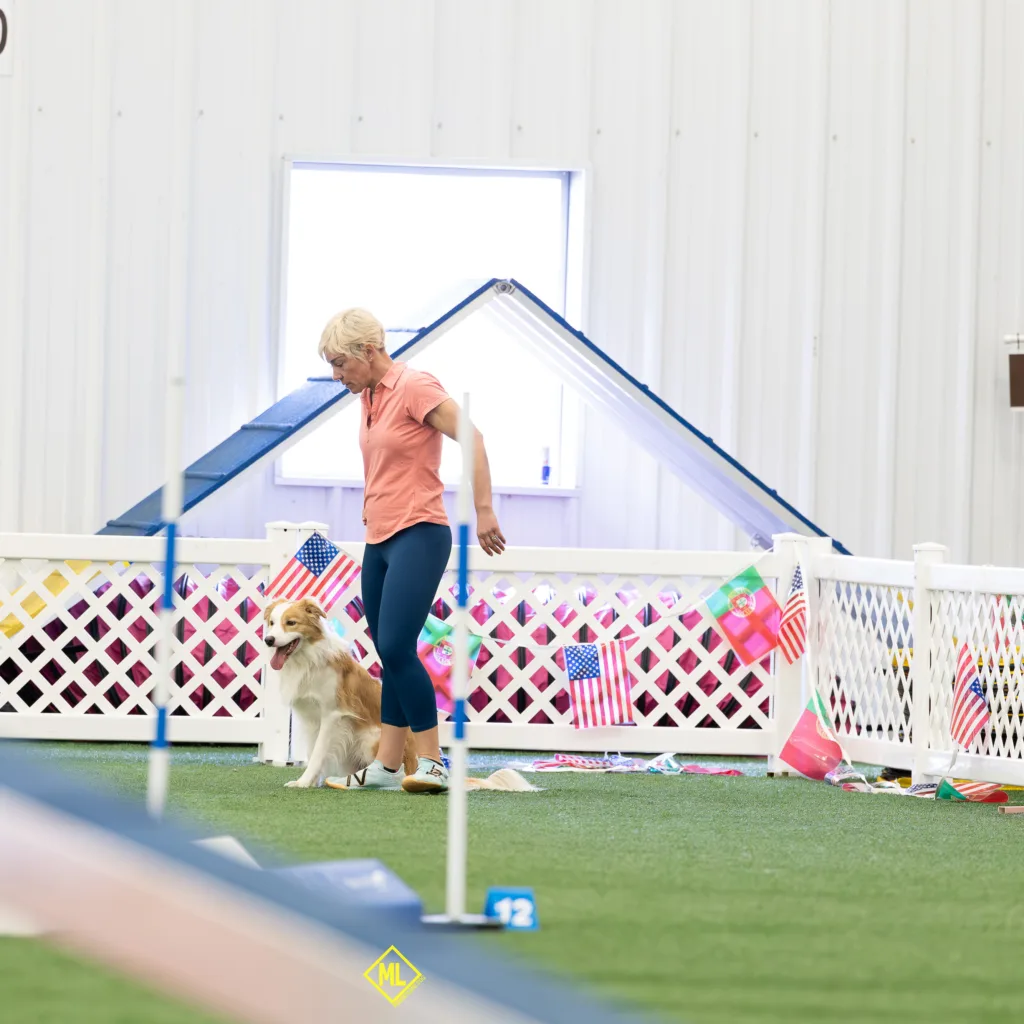
Photo Credit: Mike Lifer
What Actually Builds Duration
If repeating the cue isn’t the answer, what is? This is exactly where a duration marker does real work. A word like “good” isn’t a cue, it’s feedback. It tells your dog, in real time, “that’s correct, keep doing exactly what you’re doing.” Delivered well, often in a calmer, lower tone than a release marker, it functions almost like a small reward in its own right. Your dog gets genuine clarity and confidence from hearing it, well before any treat or toy shows up.
That’s the mechanism behind stretching a 5-pace heel into an 8-pace heel, holding a stay a few extra beats, or keeping a dog locked into a longer sequence. You’re not repeating instructions. You’re marking correctness along the way, which gives the dog real information to work with instead of noise.
Why This Matters for Complex Behaviors
Most advanced behaviors aren’t a single action, they’re chains: several smaller behaviors linked together. A full retrieve involves picking something up, holding it, bringing it back, and sitting with it. A heeling pattern involves position, attention, pace, and turns. Trying to teach or maintain a whole chain at once, with no feedback along the way, leaves a lot of room for the chain to fall apart in the middle.
A duration marker lets you give clear, real-time feedback on each individual piece as you link them together, confirming what’s correct without releasing the dog, so the whole sequence gets built (and later maintained) with real precision instead of hope.
This is one of the pieces of a genuinely complete marker system, the kind taught throughout KNOW Games: Building Resilient Dogs Through Complete Communication – available only at The Agility Challenge to Members. If you’re a member of my email list, you can get a discount on your membership; use the form at the bottom of this post to join my list if you’re not already subscribed!
Next time: we flip to the other side of the conversation entirely, what happens when your dog gets it wrong, and why a clear, honest “no” might be one of the kindest things you can teach them.